Artificial Intelligence (AI) and Machine Learning (ML) are opening fresh opportunities for students and slowly transforming the field of engineering. A B.Tech Course helps students to develop their technical skills and practical knowledge required to manage these emerging technologies in an efficient way. Institutions like Accurate Group of Institutions, a reputed Engineering College in Greater Noida, offer industry-centric B.Tech Programs that guide students in building their careers in AI, ML, and other advanced technology fields.
Today, Artificial Intelligence and Machine Learning are changing how industries operate with the help of these technologies, which are becoming a crucial part of daily operations to expand across sectors such as healthcare, finance & Banking, cybersecurity, telecommunications, automotive, robotics, agriculture, and manufacturing.
A well-planned B.Tech Program, as per current requirements not only builds strong technical base but also gives practical exposure to students through live projects, internships, and industrial experience. Studying at a reputed Engineering College in Greater Noida allows students to explore emerging technologies and prepare confidently for engineering careers.
Overview of Artificial Intelligence (AI) and Machine Learning (ML)
Artificial Intelligence refers to technology that enables machines or computers to perform tasks that require human intelligence, such as learning, reasoning and making decisions.
Machine Learning is that part of AI that allows computers to learn from data and improve their performance without the need of programming for every projects or task.
In B.tech, AI and ML are commonly used because they allow machines to process high-volume data, recognise patterns, and provide insights for organisations to make better decisions, and develop smarter technological solutions.
Artificial Intelligence (AI) Vs Machine Learning (ML)
| Aspect | Artificial Intelligence | Machine Learning |
|---|---|---|
| Definition | Technology that allows machines to perform task which require normal human intelligence |
A part of AI that helps machines learn from data and improves accuracy |
| Objective | Create intelligent systems (able to think, learn, and having decision making ability) |
Improve system accuracy and performance through learning from data |
| Examples | Virtual assistants, robotics, chatbots | Recommendation systems, predictive models, spam filters |
| Engineering Use |
Automation, smart devices, and intelligent systems |
Data analysis, forecasting, recognition of pattern |
Role of Artificial Intelligence (AI) and Machine Learning (ML) in Engineering
Engineering education level is growing rapidly to manage the latest technologies. Today’s B.Tech Programs focus on a combination of practical learning and theoretical knowledge. To enhance skills, students learn programming, algorithms, and data analysis to cope up with solve real-world engineering problems.
Institutions such as Accurate Group of Institutions, a B.Tech College in Greater Noida, combine academic learning with practical experience. Engineering students get opportunities to work in an advanced laboratory (BMW'S Engine is Part of Accurates Lab), workshops, and participate in live projects that helps them understand how new technologies work in real situations.
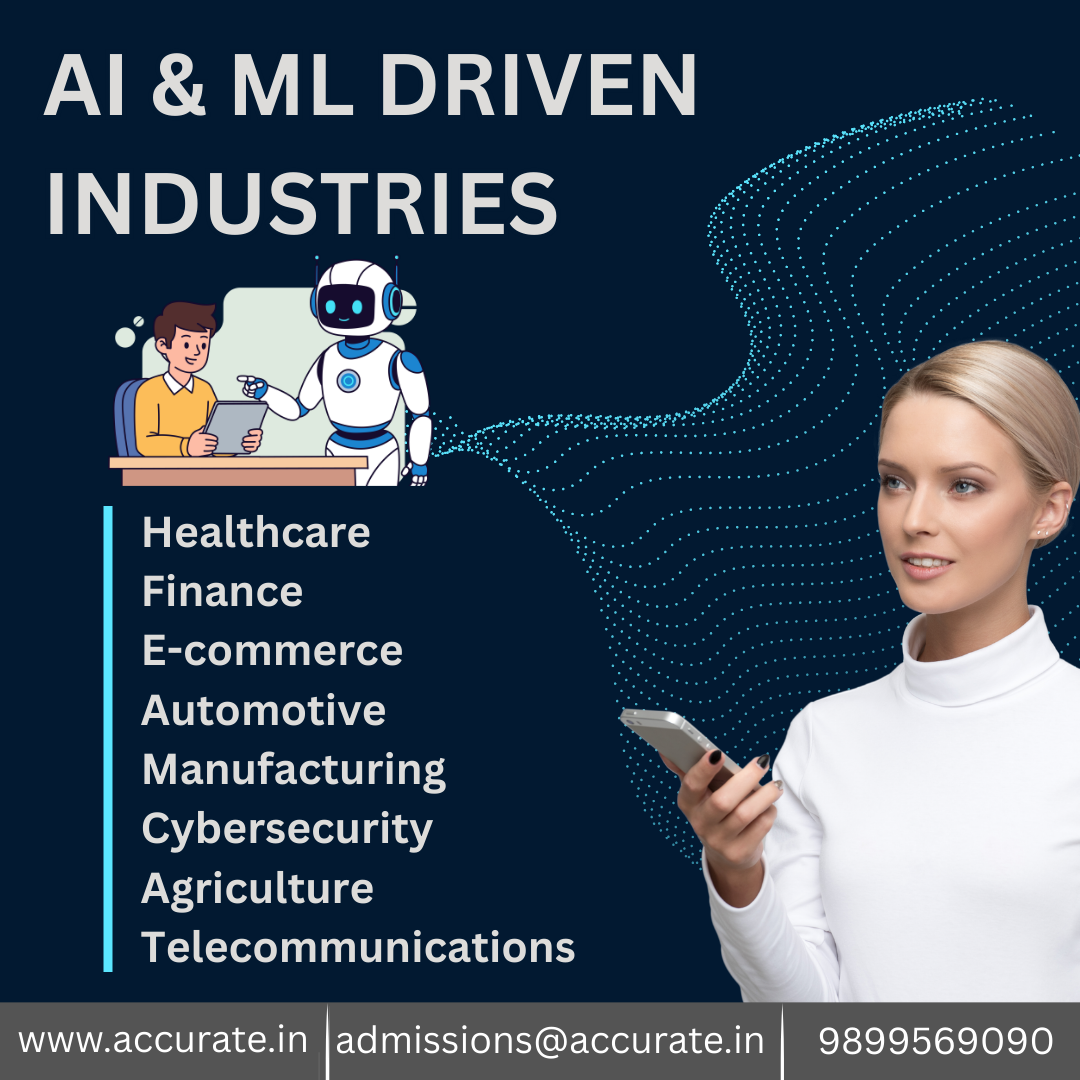
Applications of Artificial Intelligence (AI) and Machine Learning (ML) in Industries
Artificial Intelligence and Machine Learning are widely used to improve productivity, accuracy, and automation and are helpful for organizations in analysing data, predict outcomes, and make smarter decisions.
| Industry | Application of AI & ML |
|---|---|
| Healthcare | Medical image analysis, disease prediction, and data management |
| Finance | Fraud detection, risk management, and financial analytics |
| E-commerce | Personalised product recommendations, customer behavioural analysis |
| Automotive | Autonomous vehicles, smart navigation, and driver assistance systems |
| Manufacturing | Predictive maintenance, automated production, quality control |
| Cybersecurity | Threat detection, fraud identification, security & risk monitoring |
| Agriculture | Crop monitoring, smart irrigation systems, and yield predictions |
| Telecommunications | Network optimisation, fault detection, and customer service automation |
Skills Required for Artificial Intelligence(AI) and Machine Learning(ML) Careers
Students who want to build a career in Artificial Intelligence and Machine Learning need a combination of technical and analytical skills. These skills help them understand complex data, design intelligent systems, and solve real-world problems.
Some of the important key skills include programming knowledge, data interpretation, and problem-solving abilities. Programming languages such as Python and Java are commonly used in AI development. Understanding algorithms helps engineers to build efficient and reliable systems.
Deep knowledge of machine learning tools and frameworks like TensorFlow, PyTorch, and Scikit-learn is useful for developing AI-based applications. During a B.Tech Course, students can progressively develop these skills through academic projects, internships, and technical training programs.
Career Opportunities in Artificial Intelligence and Machine Learning
The growth of AI and ML technologies has created multiple high-demand job profiles for future engineers.
| Career Role | Key Responsibility | Average Salary |
|---|---|---|
| AI Engineer | Develop intelligent algorithms | 8 – 20 LPA |
| Machine Learning Engineer | Build analytical models | 7 – 18 LPA |
| Data Scientist | Interpretation of big data | 8 – 22 LPA |
| Robotics Engineer | Design automated robotic systems | 6 – 15 LPA |
| AI Research Scientist | Develop advanced AI technologies | 10 – 25 LPA |
Graduates from a Top B.Tech College in Greater Noida can explore these job roles across sectors such as Information Technology, finance, agriculture, healthcare, robotics, etc.
Future Scope of Artificial Intelligence (AI) and Machine Learning (ML)
The future of AI and ML is bright and growing rapidly as industries adopt intelligent technologies and automation. Innovations such as autonomous vehicles, smart cities, and AI-powered healthcare systems are increasing the importance of AI. In everyday routine, AI is also used in voice assistants like Alexa, e-commerce, Google Maps, facial recognition systems, smart home devices, and personalised suggestion in applications, etc.
Engineers with knowledge of AI and ML, and trained in these technologies, will play a major role in developing innovative solutions and improving efficiency across diverse industries. Students pursuing a Bachelor of Technology from a Top Engineering College in Delhi NCR can gain experience in these different types of opportunities and build careers in advanced technology.
Conclusion
Artificial Intelligence and Machine Learning are playing a crucial role in shaping the future of engineering and technology. The demand for proficient engineers in AI and ML is increasing because industries highly rely on intelligent systems and automation, the demand for engineers with AI and ML knowledge continues to grow.
Pursuing a B.Tech Course that focuses on new technologies, skill-based learning, and industry experience can help students for successful careers in this growing field.
Accurate Group of Institutions is one of the reputed Engineering College in Greater Noida, equipping students with knowledge and skills and corporate exposure needed for future-ready careers.
Frequently Asked Questions (FAQs) for Artificial Intelligence (AI) & Machine Learning (ML)
1. Can B.Tech students learn AI and ML without a computer science background?
Yes. While computer science provides a strong base, students from other engineering branches can also learn AI and ML through basic programming courses, certifications, and live projects.
2. Which programming languages are most commonly used in AI and ML?
Programming languages such as Python, Java, and R are commonly used in AI and ML development. Among them, Python is the most popular because of its simplicity and offers strong libraries such as TensorFlow, NumPy, and Scikit-learn for machine learning.
3. Do students require strong mathematical skills for AI and Machine Learning?
Yes. Basic mathematical skills are important because having a command in mathematics help us in understanding how machine learning algorithms analyze and process data.
4. Can AI and ML engineers find career opportunities in non-technology industries?
Yes. Nowadays, AI and ML professionals are highly required in almost every sector including like healthcare, banking and finance, e-commerce, automotive, cybersecurity, agriculture and manufacturing. Even in Non-technology companies use AI & ML to enhance efficiency and to take strategic decisions.

.JPG)
.JPG)